
Large and Small Equine Eyelid Speculum
Both the large (34 mm wide eyelid supports) and small (25 mm wide eyelid supports) equine eyelid speculums are very easy to use and provide uniform and wide palpebral fissure openings which Improves visualization of the equine adnexa and anterior ocular segment. They are lightweight and are easily positioned allowing, in most instances, complete visualization of and access to the entire equine cornea. The eyelid speculums are generally well tolerated by horses undergoing brief and longer-duration ophthalmic procedures performed under standing sedation (Fig. 1) and general anesthesia (Fig. 2). The small equine eyelid speculum can be used in foals, small horses or ponies, small ruminants, and in new world camelids (Fig. 3).
The lateral placement of the side supports and the wide, curved fixed and moveable horizontal supports provide a uniform and large palpebral fissure opening without causing marked tension along the temporal canthus. While the eyelid speculum can be placed with the adjustment screw above the upper eyelid or below the lower eyelid, we position the eyelid speculum with the adjustment screw located above the upper eyelid in all horses under sedation. This allows for the fixated eyelid support to be placed in the lower, less mobile, eyelid. The mobile eyelid support is placed in the upper eyelid, and all adjustments are easily carried out as the adjustment screw is not in contact with any part of the horse’s orbit or head. The adjustment screw cannot be accessed as readily when the eyelid speculum is placed with the adjustment screw placed below the lower eyelid, especially when used on horses under sedation. Under general anesthesia, this position is sometimes preferred.
The integrated millimeter scale along the external surface of the eyelid supports is a simple yet sublime detail (Fig. 4). Estimating sizes is no longer necessary and there is always an accurate reference scale in our images. It is also possible to obtain better visualization of normally, difficult to see areas, such as the temporal fornixes. This is achieved by slightly loosening the adjustment screw, thereby decreasing the distance between the eyelid supports and then gently pulling the temporal aspect of the eyelid speculum away from the horse. This can be very useful, for example, during photodynamic therapy or when more access is required when performing a temporal keratoconjunctivectomy.
The ease of use, uniform palpebral fissure opening and integrated millimeter scale make this instrument a necessary part of our daily clinical routine.
Figures
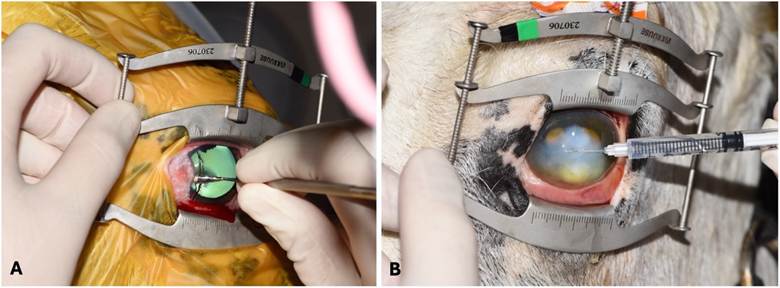
Figure 1. Large equine eyelid speculum in place in two horses undergoing a superficial lamellar keratoplasty and conjunctivectomy (A) and intrastromal injections (B).
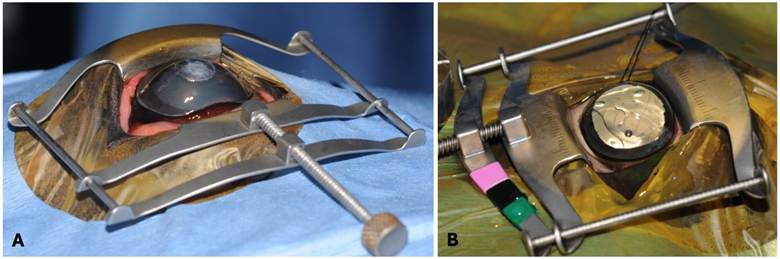
Figure 2. Large equine eyelid speculum being used in a penetrating keratoplasty (A) and cataract surgery (B).
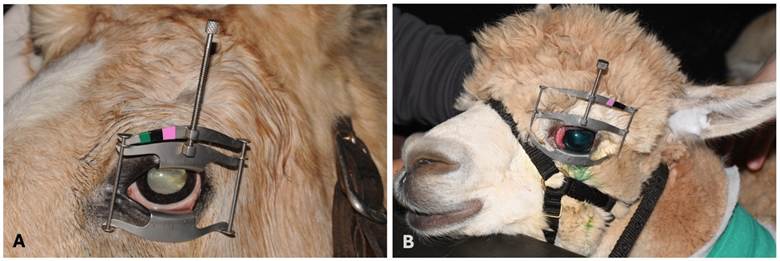
Figure 3. Small equine eyelid speculum being used in a small pony (A) and an alpaca (B).
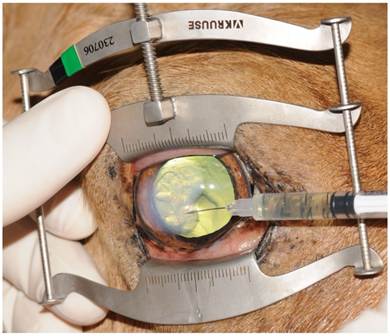
Figure 4. Note the millimeter scale on the surface of the upper and lower eyelid supports. The central mark is the tallest, for orientation, and extends for 15 mm both laterally and medially.